Airdrop Parachute: The Complete Guide to Precision Air Delivery
Recent Posts
Archives
Categories
Airdrop Parachute: The Complete Guide to Precision Air Delivery
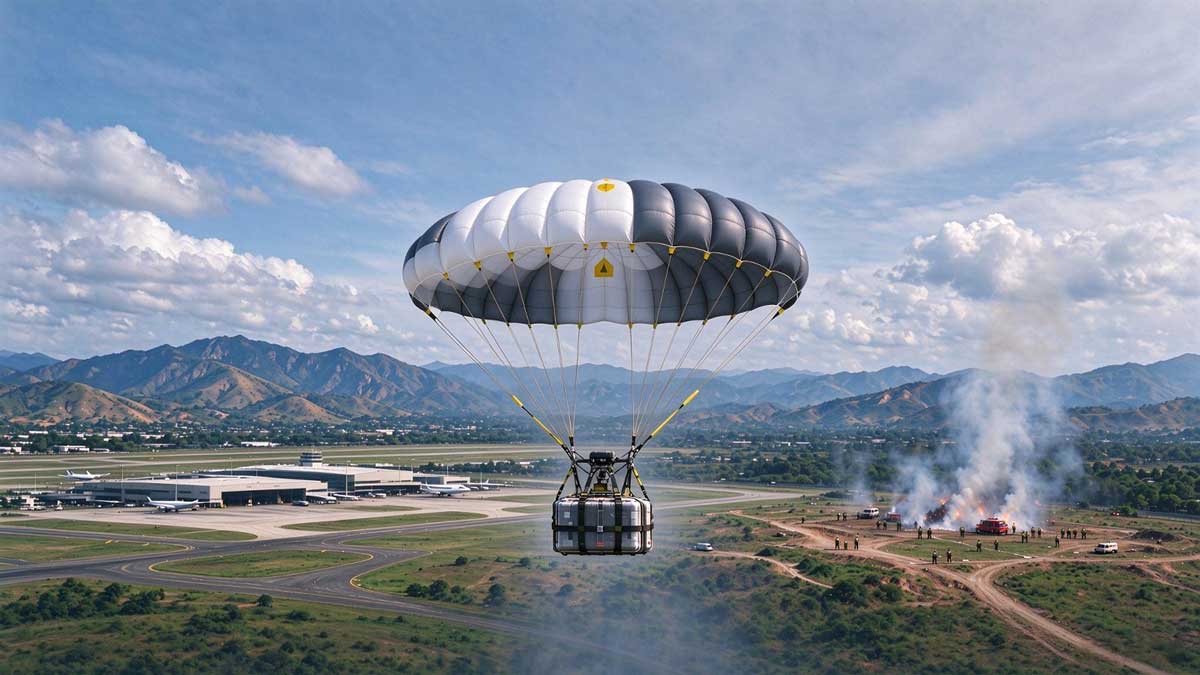
An airdrop parachute is a specially designed parachute system that allows aircraft to drop supplies, equipment, and cargo safely from the sky to the ground. It is one of the most reliable ways to deliver goods to places that are hard to reach by road, such as mountains, islands, flood zones, and disaster areas.
In this guide, we will explain what an airdrop parachute is, how it works, the main types available, where they are used, and how to choose the right one for your needs. Whether you are a logistics manager, a rescue team leader, or a drone delivery operator, this article will help you understand everything about airdrop parachutes.
What Is an Airdrop Parachute?
An airdrop parachute is different from a normal skydiving parachute. A skydiving parachute carries a person. An airdrop parachute carries cargo. It is built to handle heavy loads, high opening speeds, and tough landing conditions. The main job of an airdrop parachute is simple: slow down the cargo so it lands safely without breaking. The parachute opens in the air, creates drag, and reduces the falling speed of the load. When the cargo reaches the ground, it should touch down at a gentle speed, often around 4 to 6 meters per second, depending on the design.
Airdrop parachutes are widely used in:
Disaster relief and emergency rescue
Humanitarian aid delivery
Military and civil logistics
Drone and UAV cargo delivery
Remote medical supply drops
Construction material delivery in hard-to-reach areas
Because roads can be blocked by earthquakes, floods, or landslides, air delivery is sometimes the only way to get help to people in time. This is why the airdrop parachute has become a key piece of equipment for modern rescue and supply operations.
How Does an Airdrop Parachute Work?
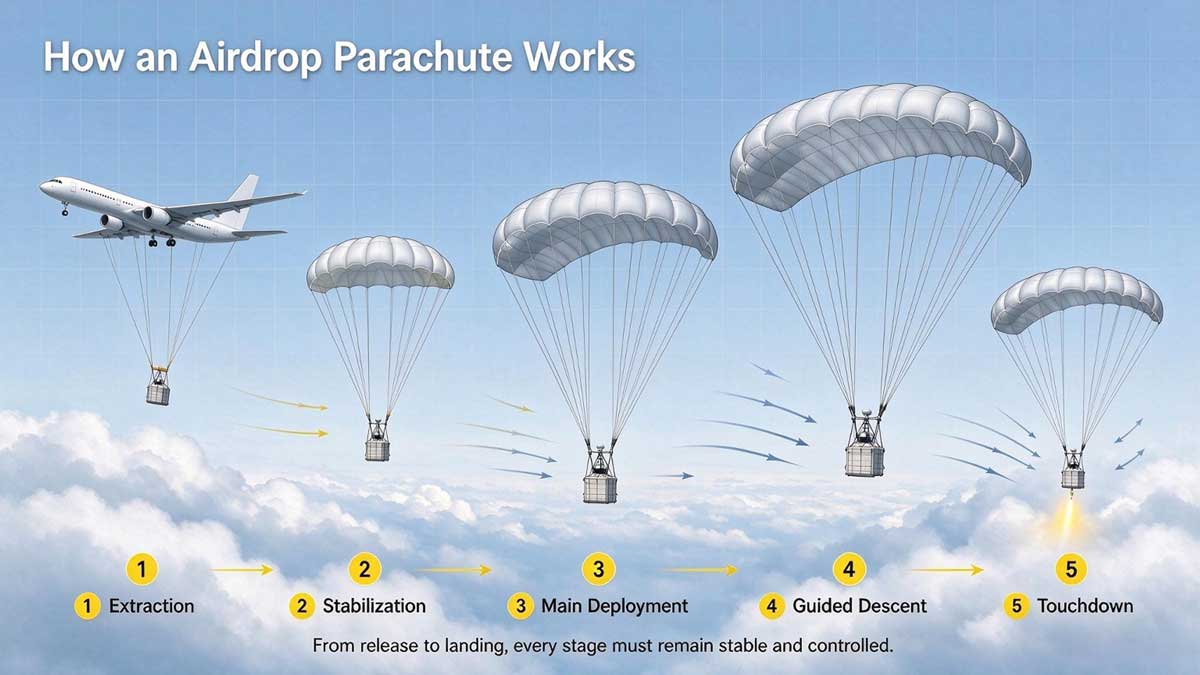
An airdrop parachute system works in several stages. Understanding these stages helps you choose the right system and use it correctly.
Stage 1: Extraction. When an aircraft drops cargo, a small extraction parachute opens first. This small parachute pulls the cargo platform out of the aircraft. This is important because the cargo is often too heavy to be pushed out by hand.
Stage 2: Stabilization. After the cargo leaves the aircraft, a stabilizing parachute, sometimes called a drogue, slows the load and keeps it stable. Without this stage, the cargo could tumble in the air, which is dangerous and can damage the parachute.
Stage 3: Main canopy deployment. The main parachute, or canopy, opens gradually to avoid sudden shock. In modern systems, this can happen automatically or by remote command. The canopy fills with air and creates enough drag to slow the load to a safe descent speed.
Stage 4: Guided descent (optional). In a precision airdrop parachute, the canopy is steerable. The system can adjust its direction during descent, much like a glider, to guide the cargo toward a target point on the ground.
Stage 5: Touchdown. When the cargo lands, the parachute reduces the impact. Some systems also use air cushions or other buffers to protect the cargo at the moment of landing.
The whole process, from leaving the aircraft to landing, usually takes only a few minutes. But each stage must work perfectly to ensure the cargo arrives safely.
Main Types of Airdrop Parachutes
There are several types of airdrop parachutes. Each type has different strengths, and the right choice depends on your mission.
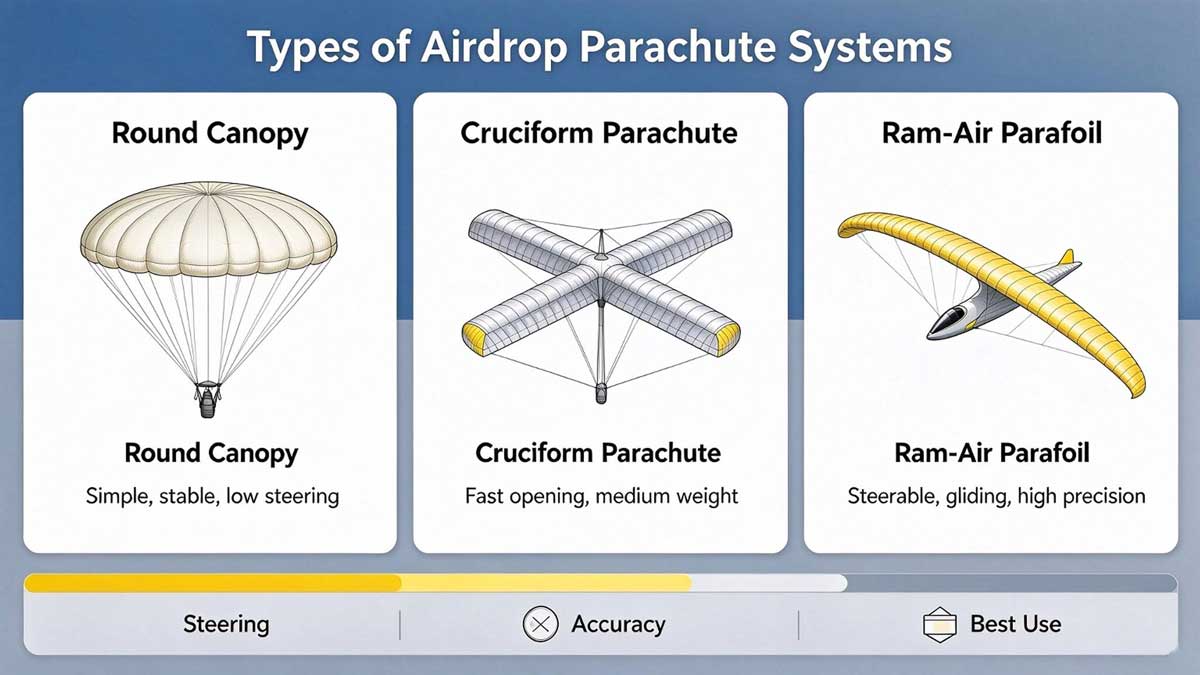
Round canopy parachute. This is the classic parachute design. It looks like a dome and works like a big umbrella. It is simple, reliable, and relatively low cost. However, it has almost no steering ability. Once it opens, it falls mostly straight down, so the landing point is hard to control. Round canopy parachutes are a good choice for basic supply drops where precision is not the first priority.
Cruciform parachute. This type is shaped like a cross. It opens more quickly and is more stable than a simple round canopy. It is often used for medium-weight loads. Still, like the round canopy, it offers limited control.
Ram-air parafoil. This is the most advanced type. It looks like an inflated wing with several cells. When air flows into the cells, the canopy becomes a gliding wing. This gives it two big advantages: it can steer, and it can glide long distances. A ram-air parafoil can guide the cargo to a precise landing point, even in windy conditions. This makes it the best choice for precision airdrop missions.
Precision-guided airdrop system. This is a ram-air parafoil combined with a smart control unit. The control unit uses GPS and sensors to navigate the parachute to a target automatically. Some systems can be controlled remotely by an operator on the ground. These systems offer the highest accuracy and are ideal for medical supplies, sensitive equipment, and time-critical rescue deliveries.
Parachute Type
Steering Ability
Landing Accuracy
Best For
Round canopy
None
Low
Simple, low-cost supply drops
Cruciform
Limited
Medium
Medium-weight stable drops
Ram-air parafoil
Good
High
Precision delivery in windy areas
Guided airdrop system
Automatic
Very high
Rescue, medical, and sensitive cargo
Where Are Airdrop Parachutes Used?
Airdrop parachutes are used in many real-world situations. Here are the most common applications.
Disaster relief. After an earthquake, flood, or wildfire, roads are often destroyed. Rescue teams use airdrop parachutes to send food, water, tents, and medicine to people in need. This is often the fastest way to deliver help.
Humanitarian aid. In remote areas with poor infrastructure, airdrop systems deliver essential supplies to communities that are cut off from normal transport routes.
Medical supply delivery. Blood, vaccines, and emergency medicine have strict temperature and time limits. A precision airdrop parachute can bring these supplies to hospitals and clinics quickly and accurately, sometimes in mountain or island areas where no landing strip exists.
Search and rescue. At sea or in canyons, rescue teams drop life rafts, communication devices, and survival kits to people waiting for help. A parachute that can be guided to a precise point is extremely valuable in these situations.
Drone and UAV delivery. Drones are becoming a common way to deliver small packages. Many delivery drones now carry a small parachute for safety. If the drone fails in the air, the parachute opens and brings the package down safely. Some large cargo drones use airdrop parachutes as their main delivery method.
Construction and logistics. In mountainous areas, some companies use airdrop systems to deliver building materials and equipment to work sites that cannot be reached by trucks.
Why Precision Matters in Airdrop Systems
One of the biggest challenges in air delivery is accuracy. In the past, cargo dropped from an aircraft could land kilometers away from the target. This created big problems. Ground crews had to search for the cargo, and sometimes the cargo was lost completely.
Modern airdrop parachutes solve this problem with precision technology. A precision airdrop system can guide the parachute to a landing point within a very small distance from the target. In the industry, this accuracy is measured by something called CEP, or Circular Error Probable.
For example, a system with a CEP of 100 meters means that half of its landings fall within a 100-meter circle around the target. High-quality precision systems today can achieve CEP values of 100 meters or better.
Precision airdrop systems bring several benefits:
Less wasted cargo. More supplies arrive at the right place, so less is lost or damaged.
Faster rescue. Ground teams spend less time searching for dropped supplies.
Safer operation. The parachute can avoid landing in dangerous spots, such as rivers, cliffs, or power lines.
Lower cost. Less lost cargo means lower cost for every delivery.
Precision systems usually offer two control modes. In fully autonomous mode, the parachute navigates itself to the target using GPS and onboard sensors. In remote control mode, an operator guides the parachute manually from the ground. Having both options gives the user more flexibility and reliability in different situations.
Meet the T505 Precision Airdrop Parachute
If you are looking for a reliable, high-performance airdrop parachute, the T505 Precision Airdrop Parachute is an excellent choice. It is a precision descent safety system designed for point-to-point cargo delivery.
The T505 uses an elliptical ram-air high-performance parafoil with a main canopy area of 340 square feet (31.6 square meters) and 9 canopy cells. It can carry payloads from 45 kg up to 250 kg, which covers most medium-size cargo missions.
Key specifications of the T505 Precision Airdrop Parachute:
Parameter
Value
Parachute Type
Elliptical Ram-Air High-Performance Parafoil
Main Canopy Area
340 sq ft (31.6 m²)
Number of Main Canopy Cells
9
Maximum Payload
250 kg
Minimum Payload
45 kg
Maximum Deployment Altitude
35,000 ft MSL (10,668 m)
Maximum Opening Altitude
25,000 ft MSL (7,620 m)
Minimum Main Canopy Opening Altitude
4,000 ft AGL (1,219 m)
Maximum Deployment Speed
150 KTAS (278 km/h)
Glide Ratio
No less than 3.5:1
Flight Speed
56–72 km/h
Descent Speed
4.3–5.6 m/s
Accuracy (CEP)
≤ 100 meters
The T505 is equipped with high-precision autonomous homing capability, which means it can guide itself to a delivery point without needing a pilot. It supports two control modes: fully autonomous mode and remote control mode. The AGU control unit is compact, with a volume under 45 × 32 × 15 cm³ and a mass under 13 kg, and it takes less than 4 hours to charge.
This system is designed for challenging environments. It works well in mountainous areas, canyons, flood-affected zones, earthquake and wildfire response, and maritime search and rescue. When roads are blocked, the T505 can deliver materials directly to the target area. It improves rescue efficiency, increases the certainty of airdrop operations, and greatly reduces the difficulty for ground crews to retrieve airdropped supplies.
Choosing the right airdrop parachute depends on your specific needs. Here are the most important factors to consider.
Payload weight. Check both the minimum and maximum payload of the parachute. The weight of your cargo must fall within this range. A parachute that is too small for the load will land too fast. A parachute that is too large will be harder to control.
Deployment altitude. Consider the altitude where you will drop the cargo. Some parachutes are designed for high-altitude deployment, above 25,000 feet. Others are made for lower-altitude drops. Make sure the system matches your operating conditions.
Landing accuracy. How close does the cargo need to land to the target? For medical supplies and time-critical rescue equipment, choose a precision guided system with a low CEP value.
Control mode. Decide whether you need autonomous operation, remote control, or both. Autonomous systems are easier to operate and need fewer trained people. Remote control gives an operator more flexibility in changing conditions.
Descent speed. A slower descent speed means a gentler landing, which protects fragile cargo. Look at the descent speed range and match it to what you are delivering.
Durability and quality. Airdrop equipment must be strong and reliable. Check the materials, stitching, and build quality. For professional use, always buy from a supplier with a proven track record.
Ease of use. Consider how much training your team needs. A well-designed system with simple controls reduces training time and human error.
Safety and Maintenance Tips
An airdrop parachute is a life-saving piece of equipment, and it must be handled with care. Follow these basic rules.
Inspect before every use. Check the canopy for holes, tears, and worn stitching. Check all lines for damage or tangles.
Pack the parachute correctly. Correct packing is the most important step. A badly packed parachute may not open properly. Always follow the manufacturer’s packing instructions.
Follow the weight limits. Never exceed the maximum payload. Overloading is one of the most common causes of airdrop failure.
Check the weather. High winds and storms increase risk. Plan drops in safe weather conditions whenever possible.
Keep the control unit charged. For precision systems, always check the battery level before a mission.
Store properly. Keep the parachute dry, clean, and away from direct sunlight when not in use.
Use certified equipment. Buy from reputable suppliers and use only certified, tested components.
Frequently Asked Questions
What is an airdrop parachute?
An airdrop parachute is a parachute system used to drop cargo and supplies safely from an aircraft to the ground. It is designed for heavy loads and precise delivery.
What is the difference between a parachute and a parafoil?
A parachute is the general name for the equipment. A parafoil is a specific type of parachute with an inflated wing shape that can glide and steer. Most precision airdrop systems use parafoils.
How accurate is a precision airdrop parachute?
High-quality precision systems can achieve a CEP of 100 meters or better, meaning most landings fall within 100 meters of the target.
Can a drone use an airdrop parachute?
Yes. Many delivery drones are equipped with parachutes for emergency safety, and larger cargo drones use airdrop systems as their main delivery method.
What is the maximum weight an airdrop parachute can carry?
It depends on the system. For example, the T505 Precision Airdrop Parachute carries payloads from 45 kg to 250 kg.